-
In each of the graph examples below, your graph should have
at least 6 nodes.
- Draw an example of a graph such that if you remove any one edge, the resulting graph remains connected.
- Draw an example of a graph such that if you remove any edge, the resulting graph is not connected.
- Draw an example of a graph such that only one edge in the graph has the property that if you remove it, the resulting graph will not be connected.
- For the graph below, show the steps in executing Kruskal's
algorithm and Prim's algorithm. Draw the graph with the
MST edges identified at each step.
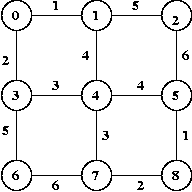
Note: Credit will not be given only for answers - show all your work: your reasoning, steps you took to get your answer etc.
The programming part of this homework has two parts:
- Part-1: Implement Kruskal's algorithm in Kruskal.java.
- Part-2: Solve a problem using Kruskal's algorithm in CableSolver.java.
Part-1:Kruskal's Algorithm
In this part, you will use Kruskal's algorithm (with an adjacency
matrix representation)
to compute the minimum-spanning tree weight of a given graph.
- Use the pseudocode given to you in Module 8 for Kruskal's algorithm. Read through this carefully.
- Name your class Kruskal.java.
- Your class will need to implement the SpanningTreeAlgorithm interface. In particular, you will need to provide implementations for these methods: initialize(), minimumSpanningTree(double[][] adjMatrix) and getTreeWeight().
- The classes and interfaces involved in this exercise are:
The Algorithm interface
The SpanningTreeAlgorithm interface - Also, Kruskal's algorithm will need an implementation of Union-Find. For this purpose, you should create a class called UnionFindInt. You can intuit what this class needs to have from its use in the Module 8 examples.
- Use the test environment to test your minimum spanning tree algorithm.
- Use this properties file for testing your adjacency matrix implementation.
Part-2: Solve the cable-laying problem.
- In this problem, we are given a collection of (x,y) points representing geographical locations. The goal is to connect them via cables so that any location can communicate with any other, going via other locations as needed.
- One approach is to simply lay a straight-line cable from every location to every other. We'll call this all-to-all.
- A lower-cost approach is to use a minimum spanning tree (MST). Thus, if location A wishes to communicate with B, and there's no direct cable from A to B, then A can communicate via some neighbor C in the MST (which means a cable between A and C), and C can use one of its cables etc until communication is established with B. This creates a path from A to B.
- Your goal is to calculate the total cable cost of each, and to report the savings obtained by using a minimum spanning tree.
- For this purpose you can use TestCable.java, which will call your code in CableSolver.java. You will also need UniformRandom.java.