SEAS Colonial Cable
Message from Dean David Dolling
|
|
Earlier this week, Mr. James Howard joined SEAS and GW as the assistant vice president for development at SEAS. I am delighted to welcome him to the School of Engineering and Applied Science and happy to be able to introduce him to you—at least initially—in this issue of the Colonial Cable. Jim comes to GW from Oberlin College, where he served as director of principal gifts and cultivated philanthropic support to build a $65 million science center and a recently completed $22 million jazz facility at the college. Prior to that, he worked in development at Cardigan Mountain School in New Hampshire. He holds a bachelor's degree and a master's degree in business from the University of New Hampshire. |
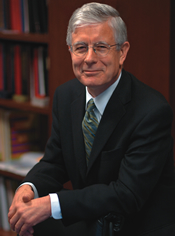
This is a pivotal time in our history, and Jim will play an important role as we move forward on the ambitious goals we have set for SEAS. We will be working together to make new investments in engineering and applied sciences to strengthen educational offerings and research activities, develop new areas of expertise, and form stronger collaborative relationships with agencies and industries in Washington, D.C., and beyond. I look forward to working with Jim and many of you to achieve these goals.
Sincerely,

David S. Dolling, Ph.D.
Dean
News & Events
- SEAS Wins Research Awards from GW's Institute for the Analysis of Solar Energy
- Prof. Plesniak Elected a Fellow of the American Physical Society
- Prof. Huang Receives a 2008 IBM Real Time Innovation Award
- Virtual Pets Roam Tompkins Hall's Fourth Floor
- American Society for Engineering Management--National Capital Section Luncheon
- SEAS Alumni Reception, Transportation Research Board 88th Annual Meeting
SEAS Wins Research Awards from GW's Institute for the Analysis of Solar Energy
In its first round of research awards, announced on November 11, 2008, GW’s newly-created Institute for the Analysis of Solar Energy (IASE) gave four of its eleven awards to SEAS, double that of the next highest school.
Professor Jonathan Deason of the Department of Engineering Management and Systems Engineering received two of the awards for his proposals, “A Linear Programming Model to Support Development and Maintenance of a Solar Grand Plan Deployment Schedule” and “Determination of Solar Energy Transition Potential of Department of Defense Facilities and Non-Tactical Vehicles.” In the first proposal, Professor Deason intends to assist in translating the Solar Grand Plan from a conceptual vision into a full implementation plan, and in the second, to assist in solving climate and energy issues by determining energy demands of Department of Defense facilities and non-tactical vehicles that could be met by renewable and solar generation.
Professor Robert Harrington of the Department of Electrical and Computer Engineering received an award for his proposal, “Analysis of the Electricity Grid - Power Management When Connected to Renewable Generation,” which attempts to identify the key parameters that govern the design and operation of a system compatible with the addition of generation from so-called renewable energy sources, particularly solar radiation. Finally, Professor Emeritus Lance Hoffman and co-principal investigators Professor John Sibert, and senior research scientist Costis Toregas, all of the Department of Computer Science, received support for their proposal to develop a computer support system for solar models and decision making. For more information on the awards, please visit: http://solar.gwu.edu/index_files/Research.htm.
Prof. Plesniak Elected a Fellow of the American Physical Society
 |
Professor Michael Plesniak |
Professor Michael Plesniak, the chairman of the Department of Mechanical and Aerospace Engineering, has been elected a Fellow of the American Physical Society (APS). According to the APS citation, Professor Plesniak was elected a Fellow for "fundamental contributions to understanding complex turbulent shear flows including the effects of curvature, multiple strain rates, three-dimensional boundary layers, and non-canonical jets in crossflow."
The APS Fellowship Program was created to recognize members who may have made advances in physics through original research and publication, or made significant innovative contributions in the application of physics to science and technology. They may also have made significant contributions to the teaching of physics or service and participation in the activities of the Society. Each year, no more than one half of one percent of the Society membership is recognized by their peers for election to the status of Fellow in the American Physical Society.
SEAS congratulates Professor Plesniak on his notable achievement.
Prof. Huang Receives a 2008 IBM Real Time Innovation Award
 |
Professor Howie Huang |
Professor Howie Huang of the Department of Electrical and Computer Engineering learned on November 22, 2008, that he has been selected as the recipient of a 2008 IBM Real Time Innovation Award for his proposal “Hippo: HIgh-Performance POwer-aware System - Building Green Computers with IBM Real-time Java Technology.”
Professor Huang explains, “As new generations of computers become ever more powerful, they consume an increasing amount of energy. There is a growing need for a real-time power management system on a per-machine basis. To this end, we plan to design and develop a HIgh-Performance POwer-aware system, called Hippo, which has the capability of monitoring and dynamically adjusting the system's power consumption in the run-time, in accordance with the user-specific policy.” While the final number of 2008 IBM Real Time Innovation Awards is not yet known, approximately 10 IBM Real Time Innovation Awards were given worldwide in 2007.
Virtual Pets Roam Tompkins Hall's Fourth Floor
People wandering into the fourth floor labs in Tompkins Hall on Tuesdays this term may have noticed a large number of students assiduously feeding and caring for their three-dimensional pets: penguins, rabbits, pterodactyls, various princes and princesses, and others; and their homes: igloos, space stations, prairies, the wild West, fantastical cityscapes, etc. “Why,” they may have wondered, “are these students not working assiduously on their computer science homework instead of fantasizing and story-telling and game-designing?”
The truth is, that's exactly what they are doing. For a goodly portion of this fall semester, students in the Computer Science 53 class taught by Professor Rhys Price Jones, Aleksander Stefanovski, Aya Kurdi Zirikly, and Ali Seyed Ahmadi have been programming in Alice, a language based on three-dimensional characters whose movements and actions are controlled by the programmer. Problem solving and story telling become synonymous. Object-oriented design is seen to be the same process as storyboard planning for a Hollywood animated movie.
Alice is presented to the world, and particularly to the computer science education community, as a gift from Carnegie Mellon University, where it was developed by a team led by Randy Pausch. If you have not seen it yet, you should watch the video "The Last Lecture" either on You Tube or on CMU's site. Randy, who died in July, left Alice as part of his significant legacy to computer science. The next version of Alice will feature characters from "The Sims," a strategic life-simulation game published by Electronic Arts. In the meantime, as you can see from examples of the students' work, they still have a lot of fun with the somewhat less-sophisticated characters currently provided.
You can see the class assignments at http://www.seas.gwu.edu/~rhyspj/cs53/cs53.html and you can download your own copy of Alice—complete with tutorials to help you learn the system—from http://www.alice.org. Have fun!
This vignette was provided courtesy of Professor Rhys Price Jones of the Department of Computer Science
Upcoming SEAS Events
Holiday Open House At Alumni House
Date: |
Thursday, December 4, 2008 |
Time: |
6:00 - 9:00 pm |
Location: |
Alumni House 1918 F Street, N.W. Washington, D.C. |
Celebrate the holidays with fellow GW alumni at an open house at Alumni House! There will be music, drinks, food and fun! Read more and register...
For a complete list of alumni events, including regional happy hours and other programming, please see the Online Alumni Events Calendar.
American Society for Engineering Management--National Capital Section Luncheon
Date: |
Friday, December 12, 2008 |
Time: |
12:00 - 2:00 pm |
Location: |
1776 G Street, N.W. Room 120 Washington, D.C. |
Join us for a lunchtime presentation by Robert Waters, professor emeritus in GW's Department of Engineering Management and Systems Engineering. Professor Waters will discuss the prospects for Pakistan International Airlines. Please visit the SEAS website for more information and to RSVP.
SEAS Alumni Reception, Transportation Research Board 88th Annual Meeting
Date: |
Tuesday, January 13, 2009 |
Time: |
5:30 - 7:00 pm |
Location: |
Omni Shoreham Hotel Washington, D.C. |
Join SEAS alumni for a reception during the 88th Annual Meeting of the Transportation Research Board in Washington, D.C. Read more and register. . .
Archives: SEAS Colonial Cable
SEAS Colonial Cables from the 2007-2008 Academic Year
SEAS Colonial Cables from the 2006-2007 Academic Year
SEAS Colonial Cables from the 2005-2006 Academic Year